Tuesday, July 31, 2012

NAVARATRI - CHUNDAL VARIETIES


The ‘nine-day ‘Navaratri’ festival is celebrated in October all over India. It is also known as 'Dussera' / 'Durga Puja' in North India - celebrating the killing of 'Mahishaasura', the demon by Goddess Durga. The 9th day is celebrated as 'Mahanavami' / 'Aayudha Puja' or 'Saraswati Puja' when books and musical instruments placed in front of Goddess Saraswati and puja is performed. As kids we'd love this day as we had to keep away from books! Next day, on 'Vijaya Dashami', toddlers are inducted to learning by the senior-most family member - by making them write 'Hari Sri Ganapathaye Namaha' on a tray of rice. Of course, after puja, every member begins with this writing and then takes out the books and starts reading. And singing too. 'Saraswati Puja' and 'Vijaya Dashami' are special days - with mini feasts at home - with vada & payasam.


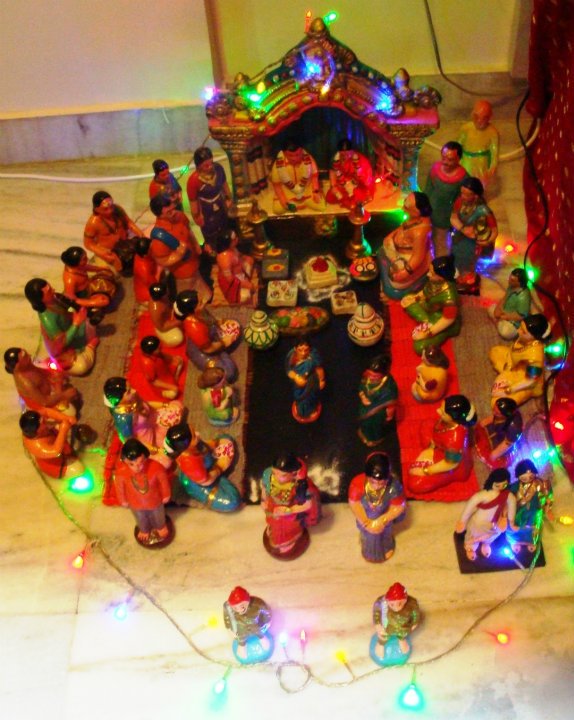
'Navaratri' is enthusiastically celebrated by the Tam Brahm ladies and girls with ‘golu’ – decoration of dolls on an odd number of steps (5, 7 or even 9) in a room, with parks, hills, and village scenes artistically arranged on the sides.Every day, puja and ‘neivedhyam’ are offered. Ladies and girls (read children) are invited for ‘manjal-kungumam’ (‘haldi-kumkum’). Music-lovers grab this opportunity to sing at the 'golu'. The fair sex are honoured with ‘vethala-paakku’ (betel leaves & betel nuts), pazham (banana) and some variety of ‘chundal’ (or 'neivedhyam' (offering) of the day). Married ladies are given a coconut and blouse piece (or some fancy item) in addition.


KADALA CHUNDAL


Ingredients
Kadalai (kala chana/ black chick peas) – 1 glass (soaked overnight in water)
Turmeric powder – ¼ tsp
Grated coconut – 3-4 tbsp
Green chilli – 2
Mustard seeds – 1 tsp
Urad dal – 1 tsp
Whole red chilli – 2
Asafetida – ¼ tsp
Curry leaves – 8
Coriander leaves – chopped fine (2 tbsp)
Oil – 4 tsp
Salt to taste
Juice of 1 lemon (optional)

Method
Wash and soak the chana for 10 hours (or overnight)
Pressure cook it with turmeric powder and ½ tsp of oil for 5-6 whistles.
On cooling, drain off the water and add required salt and mix well.
Heat 3-4 tsp of oil in a pan.
Add mustard seeds, urad dal, red chilli pieces and asafetida, followed by curry leaves.
Then add the chana and mix well.
Add grated coconut and mix well.
Add lemon juice and coriander leaves and mix well.

Tips
This can be prepared as a healthy tea-time snack.
While pressure-cooking the chana, you may lower the flame after two whistles and cook for 25 minutes and turn off the gas.


KABULI CHANA CHUNDAL


A similar chundal can be prepared with 'kabuli chana' (chick peas) with the same recipe.


MATAR CHUNDAL

The same recipe holds good for this chundal using dry white peas or dry green peas - soaking them overnight and pressure-cooking them for 3-4 whistles.


KAPPALANDI (VERKADALAI - PEANUTS) CHUNDAL


This chundal is made using peanuts. I use peanut with shells which are available at this time of the year. They have to be washed thoroughly to get rid of the mud. They have to be pressure-cooked (with the shells) with water and required salt for 3 whistles. Shell them on cooling and make chundal as mentioned in the earlier recipes - use 500 gms of peanut shells.

If it is too cumbersome, you can use 1 cup of regular peanuts - soak them in water for 3-4 hours and pressure-cook them for 3-4 whistles and prepare the chundal.


KADALAPARUPPU CHUNDAL

                     
This chundal is made with boiled chana dal (pressure-cooked for 3-4 whistles) instead of black chana.


PAYARU CHUNDAL (SWEET)


Ingredients
Vella payaru (lobhia) – 1 glass
Jaggery – 1 glass
Grated coconut – 3-4 tbsp
Turmeric powder – ¼ tsp
Salt – a pinch
Oil – ½ tsp
Ghee – 1 tsp
Cardamom powder – 1 tsp

Method
Wash and soak the vella payaru in water for a couple of hours.
Pressure-cook it with turmeric powder and ½ tsp of oil and a pinch of salt for 3-4 whistles.
Drain off the water and use it for making jaggery syrup.
Dissolve jaggery in minimum water and boil.
Add the boiled ‘payaru’ and stir well.
Continue to heat till excess water has evaporated.
Add grated coconut and cardamom powder and a tsp of ghee and mix well.
Serve hot or cold.
Tips
The same recipe can be used for ‘pachha payaru’ (green moong) – first lightly roast the whole green moong before soaking in water and pressure-cooking.


VELLAPAYARU CHUNDAL (salty) can be prepared just like the rest of the chundals after pressure-cooking it with turmeric and salt.

Vada can be prepared as 'neivedhyam' on one of the days.

© Copyright 2011. Brinda Balasubramonian.


Saturday, June 9, 2012

JANMASHTAMI - THENGOZHAL, CHEEDAI, NEYYAPPAM, VELLA AVAL


‘Janmashtami’ / ‘Gokulashtami’ celebrates the birth of Lord Krishna. Any festival is an excuse for exotic delicacies in the Indian household. The Palakkad people prepare ‘murukku’, ‘cheedai’ and ‘vella cheedai’ on this occasion and offer ‘neivedhyam’ in the late evening – closer to night – though strictly speaking it has to be done at midnight when Krishna is supposed to be born! I remember my sons issuing me strict orders that my puja should be over by 5.30 pm – when they’d land up after school – the aroma pervading the home would be too tempting to the starved boys to wait any longer. So ‘Krishna’ would ‘arrive’ at our house much earlier!

I have to admit that I have modified my offerings – my mom would make wonderful ‘murukku’ – twisting the rice dough between her fingers to make the cute creation. It was my sister or me who’d fry them carefully in oil till golden brown. In spite of my mom repeatedly insisting that we try out making ‘murukku’, we never resorted to it – and so we make ‘thengozhal’ instead – the ingredients are the same (not really - we need freshly-made rice flour from still-a-bit-moist rice & fine, dry urad dal powder - in a different proportion) – and more importantly, easier to make – requiring no special skills!

When we feel like eating 'murukku', we buy from the reputed Grand Sweets / Ananda Bhavan!

I also love the yummy ‘vella cheedai’ my mom and grandma used to make – I was also aware of their nervousness every time – wondering whether they would turn out well or disintegrate or ‘burst’. So I’ve chosen not to take the risk – I make ‘neyyappam’ instead. I wonder how many of us still make 'vella cheedai'!
Some ladies make ‘vella aval’ (Krishna’s favorite– remember – Krishna’s ‘poor’ friend Kuchela brought a little bagful of aval when he comes to meet him?) ) and ‘paal payasam’ as well.

NEIYYAPPAM
For the recipe on ‘Neiyyappam’ / ‘Appam’, please refer to the recipes of ‘Karthigai’ festival.

THENGOZHAL


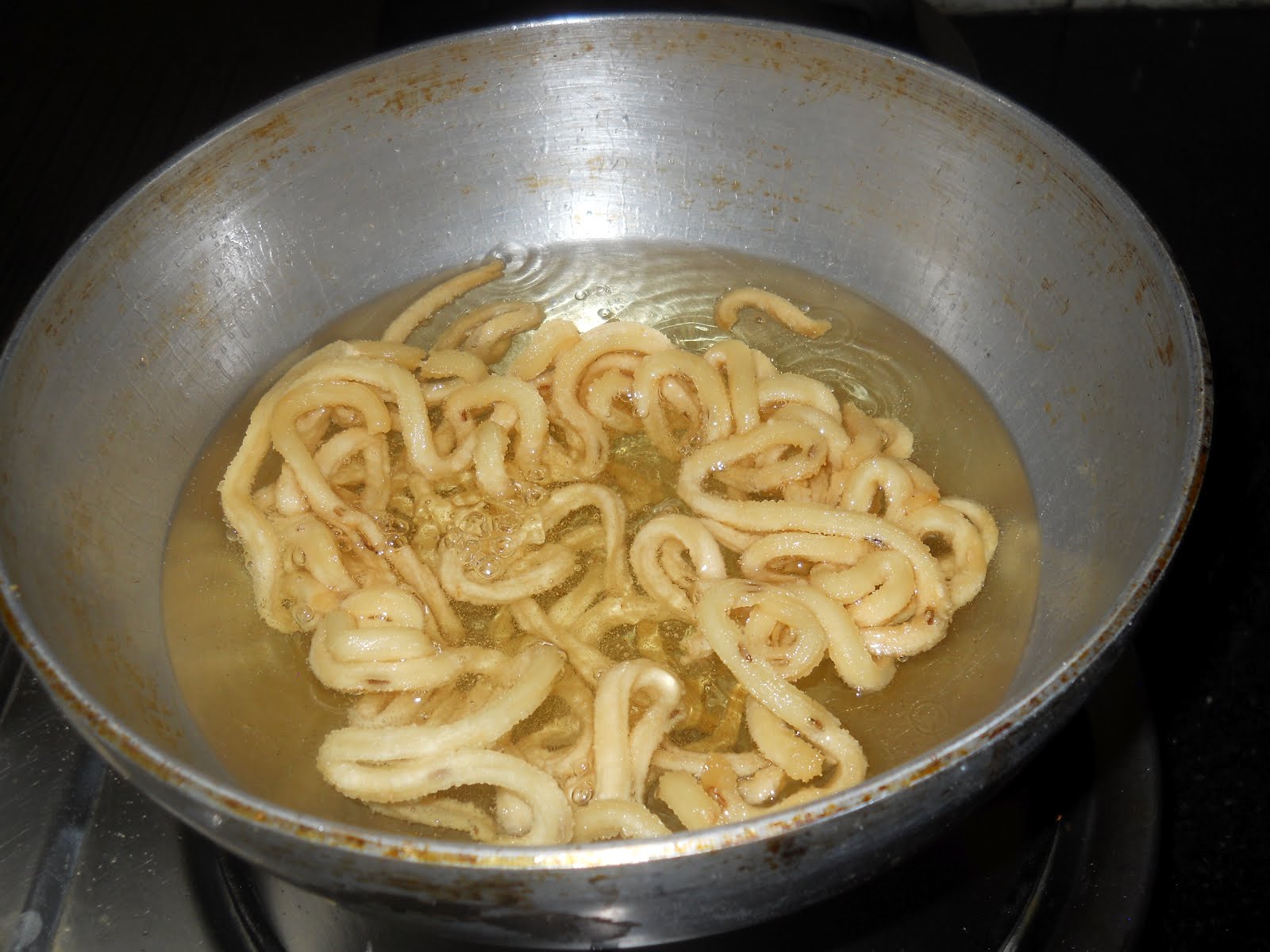
‘Thengozhal is one of the ‘murukku’ (chakli) varieties popular among Tam Brahms. It is made out of rice flour and urad dal powder. In earlier days, rice flour would be made fresh at home as also urad dal powder. Raw rice would be soaked in water for a couple of hours, drained and then powdered in a mixer after an hour or so and sieved. This fresh powder can be used while still damp for making thengozhal but it would be equivalent to half the quantity of dried rice flour. Urad dal powder can be made by dry roasting urad dal to a light brown and powdering in a dry grinder and sieving well so that you get fine urad dal powder. My mom would do that. And she'd always make with 2 1/2  cups (her cup was 250 ml). If she wanted to make more, she'd make a second batch of dough - she'd say that if the dough stood for long, the 'thengozhal' would absorb more oil. I have reduced the labor and use the powder I get ground at the flour mill; and I do make  2 1/2 cups alright but my cup size is 200 ml! In the modern day, we can use the dry rice flour and urad dal powder available in the stores in India and abroad. The recipe given below uses the powders available in the market. You can try by making with half the quantity mentioned in the recipe!

Makes 10-12 nos.

Preparation time - 15 minutes
Cooking time - 50 minutes

Ingredients –
Rice flour – 2 ½ cups
Urad dal powder – ¼ cup
Cumin seeds – 1 tsp
White sesame seeds – 1 tsp
Asafetida – nearly ¼ tsp
Butter – about 2 -3 tbsp
Salt to taste
Water
Oil for frying

Method –
Mix the rice flour & urad dal powder, adding salt, cumin seeds, white sesame seeds and asafetida. Add butter and mix well without any lumps.
Next add water to it and make soft dough. (Test for the consistency by putting a tablespoon of it in the chakli-maker and try pressing it down – if it requires you to put too much pressure, sprinkle a little more water and make the dough softer.)
Heat oil in a frying pan, squeeze the ‘thengozhal’ in circles in the oil and fry to a golden brown.
Drain off the oil and place them on tissue paper and store in a dry jar when cool.

Tips
I usually store my 'thengozhal powder' - it lasts for 3-4 months. You too can prepare this powder if you are in India. Dry roast 1 cup of urad dal (without oil) on medium heat till very light brown. Mix this with 4 glasses of raw rice. Get it finely ground from a flour mill – mentioning specifically that it should not get mixed with wheat flour. Sieve and store this powder and use whenever you want to make 'thengozhal'. Convenient if you are ready to take a little bit of initial trouble!

CHEEDAI


The same 'Thengozhal'powder / rice flour & urad dal powder in the same proportion as mentioned above (5:1) can be used for 'cheedai'.

Ingredients
Thengozhal powder - 1 1/2 cups
Coconut (grated) - 2 tbsps
Black pepper - 1 tsp
Cumin seeds - 1 tsp
White sesame seeds - 1 tsp
Butter - 1 - 1 1/2 tbsp
Salt to taste
Oil for frying

Method
Grind the coconut, jeera and pepper together with a little water.
Mix the flour well with butter, salt, and sesame seeds.
Add the ground coconut mixture and mix well.
Add water little by little to form a still dough.
Roll the dough gently and lightly into small marble-sized balls (making surethere are no cracks in the balls).
Heat oil in a kadhai and fry them in batches till golden brown.
Drain off onto a tissue paper.
Store in an airtight container on cooling.

Tips
Be careful when you roll out the marbles - don't roll tightly - they might'burst' while being fried!
Make sure the flour is sieved well - a coarse grain can also trigger off the 'cheedai burst'!
So ladies who have had a bitter experience with 'cheedai' are hesitant to try it out again! Remember - you have been warned!

VELLA AVAL

Ingredients
Aval (puffed rice) (thick variety) – 2 glasses
Jaggery – ¾ glass
Grated coconut – 2-3 tbsp
Cardamom powder – ½ tsp
Cashew nuts – 8
Pottu kadalai (chutney dal) – 1 tbsp
Ghee – 2 tsps

Method
Wash the aval and squeeze out the water gently and leave in a colander for 10 minutes.
Heat ¼ glass water in a kadhai, add the jaggery and stir.
Make a thick syrup after straining impurities if any.
Add the poha and mix well till dry. Remove from stove.
Heat 2 tsp of ghee in a small pan and fry the cashews till golden brown and remove.
In the same ghee, fry the pottukadalai till golden brown.
Add these fried stuff along with the ghee to the aval. Also add grated coconut and cardamom powder and mix well.
This dish is ready for ‘neivedhyam’ for Lord Krishna.

Tips
This is also a quick tea-time snack – nutritious and tasty.

This is prepared in some households.For the recipe, click on 'PAAL PAAYASAM' above for the link.

© Copyright 2011. Brinda Balasubramonian.


Friday, June 8, 2012

LEMON RICE


Lemon rice, also known as 'elumichambazha chadham' is a part of grand Palakkad feasts. It is an ideal packed lunch item many used to carry during train journeys. Nowadays many choose to fly and those who travel by train prefer to buy meals. 
This is a quicky. When I used to have leftover rice, my lunchbox would contain light yellow, tangy and tasty lemon rice which would disappear in no time with my friends yearning for more and suggesting that I bring the same everyday! If you want to tuck in some veggies, you are most welcome to do so!
At home, we call it 'nimbu chadham' (Hindamil) - that's how cosmopolitan our family is! Actually if you want to know the real reason, my family is more comfy with the term 'nimbu' than 'elumichambazham'. 

Serves 4

Ingredients
Rice – 1 glass
Turmeric powder – ½ tsp
Salt to taste
Mustard seeds – 1 tsp
Urad dal – 1 tsp
Chana dal / chutney dal – 1-2 tbsp
Asafetida – a pinch
Green chilli – 2 – chopped
Curry leaves – 10
Coriander leaves – 1-2 tbsp
Juice of 1- 11/2 big lemon
Oil – 4-5 tbsp
Cashew nut pieces / roasted peanuts – 2 tbsp


Method
Cook the rice, making sure it is not overcooked. 
Spread it on a plate and allow it to cool.
Heat 3 tbsp of oil in a nonstick pan add mustard seeds, urad dal and chutney dal followed by a pinch of asafetida. Add chopped green chilli and curry leaves and turmeric powder and stir.
Lower the stove and add the rice. Add salt and stir gently.
Turn off the heat.
After 5 minutes, add chopped coriander leaves and the juice of 1 lemon and mix well.
Garnish with roasted groundnuts or roasted cashews.
Serve hot / cold with papads / fryums.


Tips
Traditionally sesame oil is used. But if you are not used to its taste you can use your regular oil.
Basmati rice / Kolam rice / any good quality rice can be used - it should not be overcooked or squishy.
Lemon rice comes in handy for travel – pack it after it is cooled to room temperature.

© Copyright 2011. Brinda Balasubramonian.

THAYIR CHADHAM


'Thayir chadham' (curd rice) is a must in South Indian homes where  yogurt is a part of every meal. It is a great item to carry during travel - soothing and easy-on-your-stomach. It  tastes good with 'thayir molagai' / maangakary / pickle. 
The recipe given below is for 'thayir chadham' to be used after some 5-7 hours, so more milk is used than curd (the hours in between will see that the milk will get fermented). If you want to prepare this item for immediate consumption, add more curd and less milk and check its taste.


.
Ingredients
Rice – 1 cup
Curd – 1 cup
Milk – 3 cups
Sugar – ½ tsp
Salt to taste
Green chilli – 2 (chopped fine)
Ginger – 1” – chopped fine
Mustard seeds – 1 ½ tsp
Urad dal – 1 tsp
Asafetida – a pinch
Oil – 2 tsp

Method
Cook the rice. Cool it a bit.
Mash it a bit when still hot and allow it to cool.
Add the curd, salt, sugar and 1 1/2 - 2 cups of milk and mix well.
Add ginger pieces and mix well.
If you are going to use the curd rice soon, add more curd.
If it is for later use (after 4-6 hours), add more milk – it will have the right taste by then.
Heat oil in a small pan, add mustard seeds, urad dal, asafetida and green chilli pieces and add it to the curd rice.
Mix well.
Check the taste and serve with pickle / thayir molagai.


Tips
If you are packing curd rice for travel, just add 2 tbsp of curd and add enough milk to make the curd rice – it will turn sour and tasty with the passing hours.
It will also turn thick and solid in due course – you can add buttermilk / water later to loosen it to the right consistency.

© Copyright 2011. Brinda Balasubramonian.


Wednesday, May 2, 2012

THIRUVAADIRAI - KALI & KAAVITHU

‘Thiruvaadirai’ is celebrated in Kerala / Tamil Nadu. It falls on the ‘Thiruvaadirai’ star day of ‘Dhanu’ month – (Dec 15 – 15 Jan).
On 'Thiruvaadirai' morning, ladies wake up at dawn, have an early bath and prepare ‘kali’ and ‘kaavithu curry’ and offer ‘neivedhyam’. The family goes to temple to offer prayers.
‘Kai kotti kali’ (a graceful dance form) is performed by the ladies on the occasion.
I am giving you my sister Hema Krishnan’s recipe for Kali – it is a tried and tested hit in the family. She is an expert at making ‘kaavithu’ too – I don’t make it because my family doesn’t like it! We have ‘kali’ with home-made white butter.


Ingredients

Raw rice – 1 cup
Yellow moong dal – 1 tbsp
Jaggery – 1 ½ cups

Salt – a small pinch
Water – 2 ½ cups
Ghee – 2 tbsps
Grated coconut – 3 tbsp
Cardamom powder – ½ tsp
Cashew nuts/ raisins (optional) - 1 tbsp each

Method
Soak rice in water for half an hour. Wash well and drain off the water.
Spread and leave for one hour.
Dry roast the rice in a kadhai till it turns a yellowish brown.
Cool and powder it coarsely (like rawa) in a dry grinder. Sieve to remove fine powder if any.
Dry roast the moong dal till light brown.
Add 2 ½ cups of water and 1 ½ cups of jaggery and reduce the heat to a minimum.
When the jaggery has dissolved, add a pinch of salt and the rice flour and stir well, making sure there are no lumps.
Turn off the heat.
Pour the mixture in a vessel and put it in the pressure cooker and cook like rice. (5 - 6 minutes after a whistle).
Heat ghee in a pan, and fry cashews and raisins separately till golden brown.
When the cooker has cooled, add ghee, grated coconut, cardamom powder and fried cashews and raisins to the kali and stir well.
After offering ‘naivedhyam’ serve to the waiting family along with butter / kaavithu.

KAAVITHU


Ingredients
Kaavithu kizhangu – 250 gms - cubed
Sweet potato – 125 gms – cubed
Pumpkin – 125 gms - cubed
Broad beans (avarakka) – 100 gms – 1 cm pieces
Green peas – 3 tbsps
Potato (optional) – 1 small – cubed
Grated coconut – 3-4 tbsp
Green chilli – 1-2 (crushed)
Turmeric powder – ½ tsp
Coconut oil – 1-2 tbsp
Mustard seeds – 1 tsp
Urad dal – 1 tsp
Red chilli – 2 pieces
Curry leaves – 8-10
Salt to taste

Method
Put all the vegetables in a vessel, add enough water and add turmeric powder and salt and pressure cook till vegetables are cooked (nearly 5 minutes after a whistle).
Stir and gently mash the vegetables after the cooker cools.
Heat coconut oil in a kadhai and add mustard seeds, urad dal and red chillis, followed by curry leaves.
Add the mixed vegetables and grated coconut and crushed green chillis and stir.
Serve hot with kali.

Tips
This curry tastes good with chapathi too.
If ‘kaavithu’ is not available, you can use potatoes instead.

© Copyright 2011. Brinda Balasubramonian.

DIWALI - MUTHUSARAM & THENGOZHAL

MUTHUSARAM
'Muthusaram' is yet another member of the murukku family - a cousin of 'Thengozhal' and is made during functions like marriages, Janmashtami and Diwali.
The easiest way to get the powder is to mix 4 glasses of raw rice and 3/4 glass of yellow moong dal (dry roasted to a very light brown) and 1/4 glass of chana dal (dry roasted to a light brown). Get the mixture powdered finely in a flour mill, taking care to give instruction that it should not have any trace of wheat flour. Sieve through a fine sieve . If you get 1 kg of powder ground, you can store it for a couple of months and prepare 'muthusaram' whenever you feel like.


Ingredients -
Muthusaram powder – 2 1/2 glasses
Jeera – 2 tsps
White sesame seeds – 1 tsp
Hing – ¼ tsp
Butter – 5 tsp( about20 gms)
Water – 1 ¼ cup
Oil for frying

Method -
Mix well all ingredients except water. Add water little by little and blend well into a soft dough. (You should be able to squeeze it and make muthusaram with the 'naazhi' (chakli-maker) - without exertion. If it is too tight, loosen the dough with 1-2 tbsp of water.
Heat oil in a kadhai and make chaklis and fry both sides till golden.
Drain out on a tissue paper.
Cool and store in airtight jars. It will taste good for 3-4 weeks - but it won't last that long - it will be consumed in days!

Tips
If you live in a place where you get good rice flour, you can make the dal powder at home in your mixer - dry roast moong dal and chana dal separately till light brown. Mix them and powder in your mixer. Sieve to get fine powder and store it.
Use rice flour and dal flour in the ratio 2 1/2 : 1/4.
Whenever I'd visit my children in the US, I'd carry 1 kg of the 'muthusaram powder'. Later I started taking just the 'dal powder' as good rice flour is available at the Indian store there.

For this recipe, check out the post on 'Janmashtami'.
If you are in the US / in Indian metros, you will get rice flour as well as urad dal powder, so making 'Thengozhal' is really easy - if you have the desire, that is! 

© Copyright 2011. Brinda Balasubramonian.


Saturday, April 28, 2012

VISHU - SADHYA

Vishukkani at home in Pune.
‘Vishu’ is the new Year of Malayalees (Keralites) – Palakkad Iyers too celebrate this day as New Year – this usually falls on 14 April, at times on 15th – one day after Tamil New Year day. It is the 1st day of the the month of 'medam' in the Malayalam calendar. 
The previous day is a whirlwind rush - making rounds of Kerala stores (for those settled outside Kerala) and vegetable / fruit vendors procuring all the desired stuff. At night, a good hour or more is spent in keeping the ‘vishukkani’. The favorite God(s) (usually Krishna) presides on a table close to the bedroom. A bunch of golden yellow ‘kanikonna poo’ (flowers) is a must – these days they are sold in the ‘Kerala Stores’ along with all the other Vishu-stuff (such as pappadam, variety of chips, 'paalada', banana leaves, jack fruit etc.); a few shopkeepers are generous enough to offer a bunch of the golden flowers free to their customers. Otherwise people still pluck bunches from the blooming trees lining some roads and share with needy lookers-on!

Golden yellow 'konna' poo in full bloom
A tray of raw rice, freshly broken coconut halves filled with pulses, topped with a gold sovereign, a cup with coins and currency notes, and a mirror are a must! A pretty ‘vellarikka’ is adorned with a gold necklace and occupies pride of place. Other requisites are the lamp, agarbatti, match box, kumkum, 'vibhuti' (sacred ash) etc.

Traditionally a spread of whole vegetables and fruits (usually yellow and green in color) are arranged – green bananas, green mangoes, drumsticks, snake gourd, lime, and ripe mangoes, grapes, yellow bananas, and a whole jack fruit! These days - those of us who live outside Kerala - substitute the whole jack fruit with a small raw jack fruit or a piece of the big ripe fruit! We have started keeping whatever fruits are available in our place – watermelon, oranges, apples …. and also adding color by lining up the vegetables we normally use – tomatoes, brinjals, carrots etc. In fact, the first time my mother saw my ‘vishukkani’, she was aghast and said, “We don’t keep carrots and tomatoes!” I tried to convince her by saying, “We use them in plenty throughout the year, don’t we? So I include them too. Is there any law against it?” It took her a couple of years to accept it! On similar lines, the 'vishukkani' my daughter-in-law had arranged in the US was based on the availability and use of the vegetables and fruits there.
'Vishukkani' in the US ....
The ‘vishukkani’ is the first thing the members of the household see the moment they wake up on the new year morning – the lady of the house wakes up first, lights the auspicious lamp, prays to the Almighty and looks at every item of the ‘kani’ symbolizing plenty and prosperity throughout the year. She puts on kumkum, looks at herself in the mirror and does ‘namaskaram’. Then she wakes up each member of the family one after the other, closing their eyes with her hand till they are in front of the ‘kani’. Each one repeats the ritual. The elders give ‘vishukkai nettam’ to the rest of the family. I remember as kids, we used to get one rupee (50 years ago!). My sons used to be given Rs.11. Now the corresponding amount has increased to anything between Rs.101 and 501!
                                 
The other highlight of the day is the grand ‘sadhya’ (feast) – complete with vada, paayasam (chakka pradhaman / 'ada pradhaman' / 'paalada pradhaman' /  'paal payasam'), a couple of side-dishes including a 'thoran', koottu, avial, 'kaalan', 'olan', 'pachadi', 'kichadi' and of course sambar, rasam, pappadam, pickle and curd. Last year I had prepared all items of 'sadhya' (see photo above) for just the two of us at home - in order to present my blog post. Otherwise it is a mini feast with 4-5 dishes and chips varieties, pappadam and of course vada and payasam.

The whole family sits on the floor and enjoys the feast served on banana leaves.The banana leaf should have the narrow end to the left hand side of the eater.
'Vishu' sadhya at home ....
The items should be served in a particular sequence. Also each dish has an allotted spot on the banana leaf! Here's the complete feast served in the right sequence (as in the above photo).

First paal paayasam is served on the near right end.
Next, the dishes are served in order from the far right end of the eater -

Near-end beginning from left end -
pappadam, pazham, chakka pazham (optional), sharkaravaratty, varathuppery, chakka uppery, paruppu vada, rice, ghee, sambar and paruppu.

The steel cups from left to right at the far end contain- paayasam, rasam and curd.

FEAST ITEMS


Feast items beginning from left outer circle -
kichadi (white), pachadi (golden brown), thoran, urulakizhangu roast, koottu, olan, avial, kaalan, puli inji, maangaakary, vadai, sharkaravarati, chips, curd, paal paayasam.
Inner circle - beginning from left from near end - ghee, paruppu, rice, pappadam, sambar, rasam.

View of the same items from the other end! 

 
A grander feast will have an extra sweet ('uppittu' /‘boli’ / laddoo ) and an extra paayasam ('ada pradhaman'). Any one of the special rice varieties – lemon rice, coconut rice or tamarind rice – can be included – if desired.
Happy Vishu! Have a great year ahead! And enjoy the 'sadhya'!

                  © Copyright 2011. Brinda Balasubramonian.