Showing posts with label Palakkad koottaans. Show all posts

Sunday, April 8, 2012

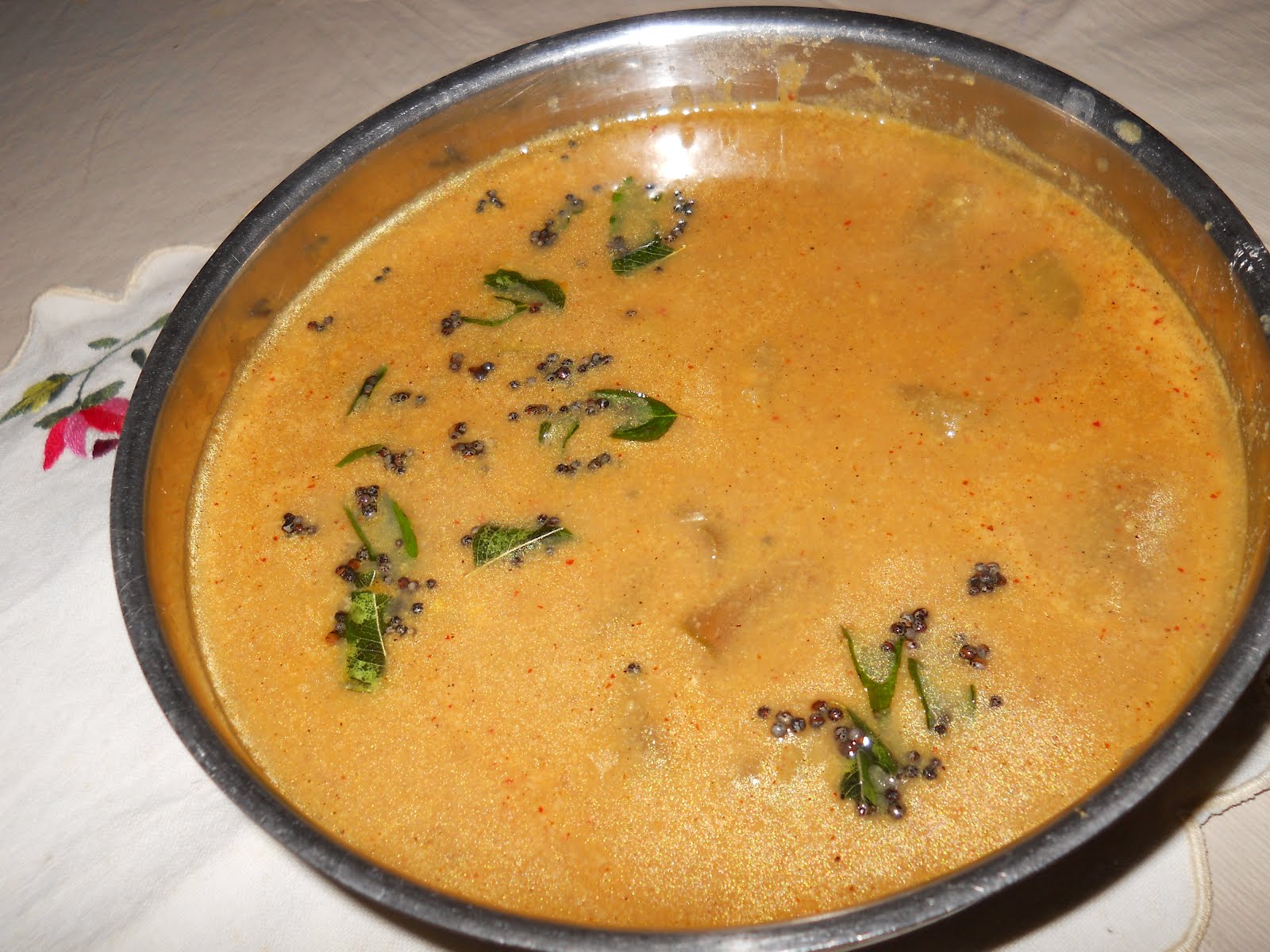
MOLAGUVELLAM

This is very light on the stomach and easily digestible as it contains no coconut / lentils. This is a common item for a new mother’s meal – and forms a great combo with bitter gourd fry / 'mezhukkuvaratti'.

Ingredients
Turmeric powder – ½ tsp
Red chilli powder – ½ tsp
Black pepper powder – 1 ½ tsp
Salt to taste
Yogurt (one day old) – 3-4 cups (whisked)
Mustard seeds – 1 tsp
Fenugreek seeds – ¼ tsp
Whole red chilli (optional)– 2 pieces
Ghee / oil – 1 tsp
Curry leaves - 8

Method
Boil 1 glass of water with turmeric, chilli and black pepper powders and salt for 5-7 minutes.
Lower the heat.
Add the whisked yogurt and mix well.
Turn off the heat before it starts boiling.
Heat ghee in a small pan and add mustard seeds and fenugreek seeds and whole red chilli pieces. When they splutter, add curry leaves and pour it in the ‘molaguvellam’.


Tips
If the yogurt is pretty thick and not too sour, this will taste just like morkootaan!

‘Morchaar’ – a very hilarious version of this simple ‘molaguvellam was a favorite of my father’s for dinner – when the leftover koottaan of the day would not suffice for all. He’d say – “I’ll make ‘morchaar’ for myself”. Well, it is prepared by adding a bowl of sour buttermilk to a ‘tadka’ of mustard and fenugreek seeds and whole red chilli, followed by curry leaves and immediately turning off the heat. Add salt to taste and mix well and use it as a ‘koottaan’! Well, what’s hilarious about it? This is nothing but a dressed version of the third course – curd rice!
© Copyright 2011. Brinda Balasubramonian.

MATHAN ERISSERY


Erissery is a part of every feast – as a side-dish. It is also made as a 'koottaan' for a homely lunch. It can be prepared with pumpkin or ‘Nendrakkai’ and yam.
It forms a good combo with thogial / pulikaachal / arachukalakki / 'maanga porukku' /maanga pachadi / Link'vendakka thayir pachadi'or the more modern 'carrot thuruval'. Usually rasam is also a part of the menu when such non-sour koottaans are prepared.

Ingredients –
Pumpkin – 500 gms - cubed
Turmeric powder – ½ tsp
Jaggery / sugar – 1 tsp
Salt to taste
Grated coconut – 8 tbsp
Cumin seeds – 1 tsp
Urad dal – 2 tsp
Whole red chilli – ½
Mustard seeds – 1 tsp
Oil – 2 tsp
Curry leaves - 7

Method
Wash the cubed pumpkin pieces.
Heat 1 glass of water in a pan and add the pumpkin pieces.
Add turmeric, salt and jaggery and cook covered on a low flame till it becomes tender.
In a drop of oil, roast 1 tsp of urad dal. Add ½ red chilli when it turns light brown.
Grind the roasted dal-red chilli with cumin seeds and 8 tbsp grated coconut.
Lightly mash the pumpkin and add the ground coconut and boil.
If it is not thick enough, dissolve a tsp of rice flour in a tbsp of water and add to the koottaan and boil.
Heat 1 ½ tsp oil. Add mustard seeds and urad dal. When they crackle, add 1 tbsp of grated coconut and fry on low heat till golden brown.
Add curry leaves and transfer it to the erissery.


Tips
Kerala plantain (1) and yam (200 gms) – cubed and boiled – can be used instead of boiled pumpkin to make erissery.
© Copyright 2011. Brinda Balasubramonian.

KEERA MOLAGOOTTAL


'Keera molagoottal' is originally made with 'arkeerai' but the modern homes use spinach. A wholesome 'koottaan', it tastes great with 'puliakuthi uppery' / thogial / pulikaachal / arachukalakki / 'maanga porukku' /maanga pachadi / 'vendakka thayir pachadi' / 'kichadi'/ or the more modern 'carrot thuruval'. Usually rasam is also a part of the menu when such non-sour koottaans are prepared.

Ingredients
Spinach - 1 bunch
Yellow moong dal – ¼ cup
Haldi – ½ tsp
Salt to taste
Urad dal – 2 tsp
Red chilli – ½
Jeera – 1 tsp
Grated coconut – ½ cup
Oil – 1 tsp
Mustard seeds, urad dal – 1 tsp each
Coconut oil - 1 tsp

Method
Wash, chop and boil the spinach with haldi. Mash well.
Pressure-cook the moong dal.
Dry roast the urad dal and red chilli and grind along with jeera and coconut.
Add the ground mix and cooked dal to the boiled spinach and add required amount of water to get the consistency of thick sambar and boil.
Heat oil, add mustard and urad dal. When they splutter, add to the koottaan.

Tips –
Toor dal too can be used instead of moong dal.
'Arkeerai' / 'thandu keerai' can be used instead of spinach.
Cabbage molagoottal can be made in a similar manner - with finely chopped cabbage and a cubed potato instead of spinach - just don't mash them after cooking. 
© Copyright 2011. Brinda Balasubramonian.

MOLAGOOTTAL


'Molagoottal' is a popular non-sour 'koottaan' - it goes well with a sour side-dish - thogial / pulikaachal / arachukalakki / 'maanga porukku' /'maanga pachadi' / 'vendakka thayir pachadi' / 'kichadi' or the more modern 'carrot thuruval'.Usually rasam is also a part of the menu when such non-sour koottaans are prepared.

Ingredients
Ash gourd/ bottle gourd – 1cm. cubes – 1 cup
Raw banana – 1 – cubed
Yam –cubed – ½ cup
Carrot – 1 – cubed
Potato - 1 small – cubed
Peas – 1 tbsp
Beans – chopped – 1 tbsp
Yellow moong dal – ¼ cup
Haldi – ½ tsp
Salt to taste
Urad dal – 2 tsp
Red chilli – ½
Jeera – 1 tsp
Grated coconut – ½ cup
Oil – 1 tsp
Mustard seeds, urad dal – 1 tsp each
Curry leaves

Method
Pressure-cook the vegetables and washed dal with haldi and salt for 2 whistles.
Dry roast the urad dal and red chilli and grind along with jeera and coconut.
Add the ground mix to the boiled vegetables and add water required amount of water to get the consistency of thick sambar and boil.
Heat oil, add mustard and urad dal. When they splutter, add curry leaves and add to the koottaan.
Note – Toor dal too can be used. Dal can be pressure-cooked separately and added to the cooked vegetables.
You can also add a tbsp of roasted grated coconut.
 © Copyright 2011. Brinda Balasubramonian.

MOLAGOOSHIAM

A very light and wholesome koottaan, it is prepared for a light dinner. It is also a part of the diet for the new mother. A tablespoon of 'moong dal' can be added to the vegetables while cooking to make it more nutritious.
As it is not sour, 'Molagooshiam' goes well with a sour side-dish - thogial / pulikaachal / arachukalakki / 'vendakka thayir pachadi' / 'maanga porukku' / 'maanga pachadi' or the more modern 'carrot thuruval'. Usually rasam is also a part of the menu when such non-sour koottaans are prepared.

Ingredients
Ash gourd/ bottle gourd – 1cm. cubes – 1 cup
Raw banana – 1 – cubed
Yam –cubed – ½ cup
Carrot – 1 – cubed
Potato - 1 small – cubed
Peas – 1 tbsp
Green chilli – 2 (slit)
Eggplant – ½ - cubed (optional)
Small bean lentils – ¼ cup (soaked for a couple of hours) (optional)
Yellow moong dal – 1 tbsp (optional)
Haldi – ½ tsp
Red chilli powder – 1 tsp
Black pepper powder – 1 tsp
Coconut oil – 1 tsp
Salt to taste
Curry leaves

Method
Wash all the cubed vegetables. Add water to cover it. Add haldi, red chilli powder, pepper powder and salt and the slit green chillies. If adding the optional ingredients, wash and add them to it. Pressure-cook it for 2 whistles. Cool. Mix well. Add water to get the right consistency (like dal). If it is too watery, dissolve a tsp of rice flour/wheat flour in a tbsp of water and to the gravy and boil. Add a tsp of coconut oil. Garnish with curry leaves.

Tips –
Instead of the above mentioned vegetables, it can also be prepared with 1 green plantain (Kerala ‘nendrakkai’) and 250 gms yam ( cubed)
.© Copyright 2011. Brinda Balasubramonian.

PORICHA KUZHAMBU

Poricha kuzhambu is a very light ‘koottaan’ as it contains no dal and very little coconut. It is paired with ‘paruppu thogial’ – which has dal and so the balance is maintained! If you feel like, you can make a 'thoran' - cabbage / beans.
 

poricha kuzhambu & paruppu thogial
Ingredients -
Tamarind – 1 lemon-size ball (soaked in water and pulp extracted)
Vella payaru (Black-eyed peas) - 3-4 tbsp – soaked in water for an hour or more and pressure-cooked
Raw banana – 1 – diced (small)
Yam – 150gms – diced (small)
Brinjal –1-2 - diced
Arbi (Colocasia) – 100 gms (4) - diced
Coconut – 1 tbsp (grated)
Urad dal – 2 tbsp
Whole red chillies – 3
Asafetida – ¼ tsp
Turmeric powder – ½ tsp
Salt to taste
Oil – 2 tsp
Mustard seeds – 1 tsp
Coconut – cut in small pieces (like child’s teeth!) – 1-2tbsp
Curry leaves – 10

Method
Extract tamarind pulp (or you may also use 1 tbsp of tamarind paste with 1 -1 ½ cups of water added to it.
Add the chopped vegetables to it.
Add turmeric powder and salt.
Pressure-cook it for 2 whistles along with vella payaru in water in a separate vessel.(The vella payaru will not get cooked in the tamarind water). Allow to cool.
In 2 drops of oil, dry roast 1 ½ tbsp urad dal till light brown. Add the whole red chillies and stir for a minute. Turn off the flame. Sprinkle ¼ tsp of asafetida to it. Grind this in a mixer along with a tbsp of grated coconut.
Mix the vegetables, cooked payaru and ground coconut paste and stir well.
Add water to get pouring consistency and boil. It should not be very thick as it will thicken a little on cooling.
Heat 1 tsp of oil, add 1 tsp of mustard seeds and 1 tsp of urad dal. When they begin to splutter, add the chopped coconut pieces and fry on low heat till golden brown.
Turn off the heat and add curry leaves and pour it into the poricha kuzhambu.

Serve with rice and paruppu thogial and any 'thoran'.

© Copyright 2011. Brinda Balasubramonian.

PULUNGARI

There are two types – ‘thenga arachuvitta pulingari’ and podi podicha pulingari’. Neither has any dal. The former has a lot of coconut. If you want to have something light on your tummy, go for the latter which has no coconut. I remember my mother tell me in her seventies – “Yesterday we had sambar with dal and coconut, let it be simple today – may be ‘podi podicha pulingari’!
As this 'koottan' has no lentils, it is ideal with cabbage / beans / 'kothavarakka usili' or 'koottu' / mathan koottu / 'payaru puzhukku' / 'mezhukkuvaratti' / 'idichakka thoran' / urulaikizhangu roast.


(a)Thengai arachuvitta pulungari
Ingredients –
Tamarind – 1 big lemon sized ball (soaked in water)
Ash gourd / bottle gourd – 300 gms - cut in 1” cubes
Brinjal – 1 – cut
Bhendi (Okra) – 7 – 8 – cut in 1”
Arbi (Colocassia) – 3-4 – cubed (pressure-cooked in a little tamarind water)
Snake Gourd (optional) – 50 gms – cut in 1” cubes
Turmeric powder – ½ tsp
Salt to taste
Oil – 1 tsp
Mustard seeds – 1 tsp
Curry leaves – 6-8
To grind –
Mustard seeds – 1 level tsp
Fenugreek seeds – ½ tsp
Whole red chilli – 3 - 4
Raw rice – 1 ½ tbsp
Curry leaves - 7
Grated coconut – 7-8 tbsp

Method -
To grind - Dry roast the mustard and fenugreek seeds in a drop of oil. When they begin to splutter, add the whole red chillies and fry for some seconds and transfer to a plate. Then dry roast the raw rice till it becomes crisp. Add 4-5 curry leaves to the roasted rice and stir for a few seconds. Put all the roasted stuff and grated coconut in the mixer and grind well.

Remove tamarind pulp. 
Add the cut vegetables. Add enough water to cover the vegetables (about 1 ½ cups) and cook covered on a low heat adding turmeric powder and salt.
Keep stirring in between.
When the vegetables become tender, add the ground paste and required quantity of water and boil well. It should not be very thick as it will thicken on cooling.
Take 1 tsp oil in a small kadhai and add mustard seeds. When they splutter, add curry leaves and empty it into the pulungari.


(b) Podi podicha pulungari
This is very light – it has neither lentils nor coconut.

Ingredients -
Tamarind – 1 big lemon sized ball (soaked in water)
Ash gourd / bottle gourd – 300 gms - cut in 1” cubes
Pumpkin – 200 gms - cubed
Brinjal – 1 – cut
Bhendi (Okra) – 6-7
Arbi (Colocasia) – 3-4 – 1” pieces (pressure-cooked in a little tamarind water)
Snake Gourd (optional) – 50 gms – cut in 1” cubes
Turmeric powder – ½ tsp
Salt to taste
Oil – 1 tsp
Mustard seeds – 1 tsp
Fenugreek seeds – ¼ tsp
Curry leaves – 6-8
To powder –
Raw rice – 1 tbsp
Boiled rice – 1 tbsp
Fenugreek seeds – ½ tsp
Whole red chilli – 3-4
Mustard seeds – ½ tsp

Method -
To make the powder –
Heat 2 drops oil in a small pan. First add the mustard seeds and fenugreek seeds. When they splutter, remove and keep them on a plate. Next, roast both the rice till they are crisp. Add the whole red chillies and stir for a minute and transfer to the same plate. Cool a bit and powder in a mixer.
Extract the tamarind pulp, add a cup or more of water and add the cut vegetables to it.
Add turmeric powder and salt and cook covered on low heat.
Stir in between till the vegetables become tender.
Add 3 tsps of the powder to the cooked vegetables and add water till it has a ‘thin sambar’ consistency. (This will thicken on cooling).
Heat 1 tsp oil and add mustard and fenugreek seeds followed by curry leaves and them to the podi podicha pulungari.

Tips –
You can make this powder and store it. It is used for ‘puliakuthi uppery’ also.
 © Copyright 2011. Brinda Balasubramonian.

PARIKKA PITLA


'Parikka Pitla' has lentils, so it is good to have a side-dish with fiber - any of the 'thoran' varieties like cabbage / avarakkai /pudalanga thoran / payaru vegetable thoran.

Ingredients –
Tamarind – 1 big lemon-sized ball – soaked in water
Tuvar dal – nearly ¾ cup
Bitter gourd – 200gms – cut in thin semi-circles
Carrot – 1 – diced / Capsicum – 1 – cut
Urad dal – 1 tbsp
Whole red chilli – 3
Asafetida – ¼ tsp
Whole black pepper – ½ tsp
Turmeric powder – ½ tsp
Grated coconut – 2 tbsp
Salt to taste
Jaggery – 1 tsp (optional)
Oil – 1 tsp
Mustard seeds – 1 tsp
Curry leaves – 7
Green coriander – 1 tbsp – (finely chopped)

Method –
Sprinkle salt to the bitter gourd pieces and leave for half an hour.
Wash well and fry in a tsp oil for 5 minutes.
Extract the tamarind pulp and 1 cup of water and heat.
Add all the vegetables and turmeric powder, salt and jaggery and boil. Lower the heat and cook covered till vegetables are tender.
In a drop of oil, roast ¾ tbsp of urad dal till golden brown. Then add the black pepper, whole red chillies and asafetida. Grind this with 2 tbsp of coconut.
Pressure-cook tuvar dal and mash well when cooled.
Add the coconut paste and mashed dal to the boiled vegetables. Add enough water to reach pouring consistency (like thick sambar).
Boil well.
In a tsp of oil, add mustard seeds and the remaining urad dal followed by curry leaves and add it to the ‘parikka pitla’
Garnish with chopped coriander leaves after 10 minutes. 

 © Copyright 2011. Brinda Balasubramonian.

Saturday, April 7, 2012

MAAMBAZHA KOOTTAAN


'Maambazha koottaan' / 'Maambazha pulisheri' is a variant of 'morkoottaan' – it is a bit sweet as it is made with small ripe mangoes. 'Urulaikkizhangu roast', 'mezhukkuvaratti', 'chembu roast' and 'kothavarakka usili' taste great with 'maambazha koottaan'.

Ingredients –
Small ripe mangoes – 4
Grated coconut – 8 tbsp
Green chillies – 2-3
Turmeric powder – ½ tsp
Red chilli powder – ½ tsp
Jaggery / sugar – 1-2 tsp
Salt to taste
Yogurt (one day old) – 3 - 4cups (whisked)
Mustard seeds – 1 tsp
Whole red chilli – 2 pieces
Oil – 1 tsp
Curry leaves - 8

Method –
Wash the mangoes and cut out 2 big pieces of each. Add the rest of the mangoes as such. Add ¾ cup of water and add turmeric and chilli powders, jaggery and salt and cook covered on low heat till the mangoes are tender.
Grind coconut and green chillies.
Add the ground coconut to the cooked mango and bring to boil.
Lower the heat. Add whisked yogurt and mix well.
Turn off the heat before it starts boiling.
Heat one tsp oil in a small pan and add mustard seeds and red chilli pieces. When they crackle, add curry leaves and transfer to the mambazhakoottaan.
Tips
The ‘koottaan’ should not come to a boil as it will curdle due to the yogurt added.
The mango with the seed is enjoyed during the meal. But if you find it cumbersome, peel and cut the mangoes into large pieces and boil and proceed.
‘Nendrapazham’ (Kerala plantain) (1 - 2 plantains cut in ½ “ thick circles) can be used in place of mangoes to make ‘nendrazha morkoottaan’.
 © Copyright 2011. Brinda Balasubramonian.

MAANGA KOOTTAAN


'Maanga koottaan' is prepared using mango, coconut and curd as main ingredients. It is somewhat similar to 'morkoottaan' but uses less curd as mango imparts its sourness. During my four-year stay with my paternal grandparents and aunt in Thrissur as a teenager, I've heard them call this koottaan, "maangayum, elavanum thenga arachuvitta koottan". Sometimes we'd end up calling it "thegayum maangayum elavan arachuvitta koottaan"!

The best side-dish for this koottaan is 'idichakka thoran' - this used to be the ideal combo at my parents' - and my father would excitedly chime in - "innakki oru vettu vettanam".  
'urulaikkizhangu roast', 'mezhukkuvaratti', 'parikka mezhukkuvaratti', 'chembu roast' and 'kothavarakka usili' taste great with it too.

Ingredients –
Ash gourd / bottle gourd – 250 gms – cubed
Mango – ½ - cut in big pieces
Drumstick – 2 – cut in 3” long pieces
Colocassia (optional) – 3 – cubed (pressure-cooked for 2 minutes)
Turmeric powder – ½ tsp
Salt to taste
Grated coconut – 8 tbsp
Raw rice – 1 tbsp
Fenugreek seeds – ½ tsp
Whole red chillies – 3 – 4
Yogurt – 6-7 tbsp - whisked
Mustard seeds – 1 tsp
Oil – 1 tsp
Curry leaves - 8
 
Method
Wash the cut vegetables. Add 1 cup of water and boil with turmeric powder and salt till they become tender.
To a small pan, add a drop of oil and add raw rice and fenugreek seeds and roast. When they start crackling, add the red chillies and roast for a minute.
Grind the roasted stuff with the grated coconut.
Add the ground paste to the boiled vegetables and bring to boil.
Lower the heat. Add whisked yogurt and mix. Turn off the heat before it starts boiling.
Heat oil in a small pan, add mustard. When they start spluttering, add red chilli pieces and curry leaves and transfer it to the ‘maanga koottaan’.

Tips -
The ‘koottaan’ should not come to a boil as it will curdle due to the yogurt added.

 © Copyright 2011. Brinda Balasubramonian.